

Almost everyone has heard of folic acid — especially women who have been trying to conceive or who are in the first or second trimester of pregnancy. Folic acid is widely recommended as a way to help prevent developmental defects in the foetus. Less well known, however, are folates — even though both folate and folic acid are forms of the same nutrient: vitamin B9. More precisely, they represent two different forms of this essential vitamin. But are there meaningful differences between them? And is one form better than the other?
What Are Folates?
Folate is the naturally occurring form of vitamin B9 — an essential nutrient that the body cannot produce on its own. In nature, vitamin B9 is found precisely in this form. The term "folate" is actually a general name for a group of related compounds with similar nutritional properties. The biologically active form of vitamin B9 is known as levomefolic acid or 5-methyltetrahydrofolate (5-MTHF). This is the form that enters the bloodstream directly, from where it is distributed throughout the body to fulfil a range of vital functions.
Among its most important roles, folate contributes to normal cell division, supports the formation of red blood cells, and plays a crucial role in foetal development during pregnancy. It is also associated with cardiovascular support and may contribute to healthy homocysteine metabolism — a factor linked to heart health. Folate is part of the broader vitamin B family, all of which work together to support energy metabolism and nervous system function.
What Is Folic Acid?
Folic acid — the form most commonly recommended by doctors and gynaecologists — is the synthetic form of vitamin B9, also known chemically as pteroylmonoglutamic acid. It is the form most frequently used in dietary supplements and is often added to fortified food products to improve their nutritional value.
For many years, folic acid was considered superior to natural folate, largely because it was believed to have higher bioavailability. However, more recent research has revealed an important distinction in how these two forms are processed by the body. Unlike natural folate, which is converted to its active form (5-MTHF) directly in the digestive tract, folic acid must first travel to the liver for conversion. This makes the process considerably slower and less efficient.
What makes this distinction clinically relevant is that the liver's capacity to convert folic acid is limited. Even moderate doses may not be fully metabolised, leading to the accumulation of unmetabolised folic acid in the bloodstream. This has raised concerns among researchers, as elevated levels of unconverted folic acid have been associated with potential masking of vitamin B12 deficiency — a condition that, if left undetected, can lead to neurological complications.
Folate vs Folic Acid — Which Form Is Better?
In light of current scientific understanding, the once-assumed superiority of folic acid over natural folate appears to have been based on incomplete knowledge. While folic acid is undoubtedly a more affordable form of vitamin B9, its popularity may not be entirely justified when better alternatives are available.
Natural folate — and particularly its supplemental equivalent, methylfolate (5-MTHF) — offers several advantages:
- Faster absorption — folate is converted to its active form directly in the digestive system, bypassing the liver
- Higher bioavailability — the body can utilise it more efficiently
- No accumulation risk — unlike folic acid, natural folate does not build up as unmetabolised compounds in the blood
- Safer for individuals with MTHFR gene variants — people with common MTHFR polymorphisms may have difficulty converting folic acid, making methylfolate the preferred choice
Does this mean folic acid should be avoided entirely? Not necessarily. In situations of confirmed deficiency, folic acid supplements can still help restore adequate vitamin B9 levels, as they contain sufficient amounts to compensate for the slower conversion process. However, when given the choice, methylfolate-based supplements represent a more direct and efficient way to support vitamin B9 status.


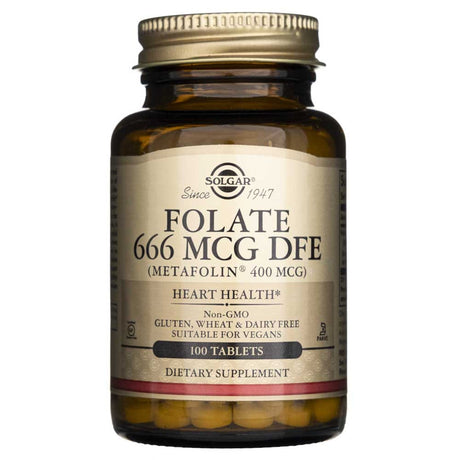


Solgar
Solgar Folate 666 mcg DFE (Metafolin® 400 mcg) - 100 Tablets
Regular price €15.39Unit price€0.15 each


Jarrow Formulas
Jarrow Formulas Methyl Folate 1000 mcg - 100 Veg Capsules
Regular price €28.29Unit price€0.28 each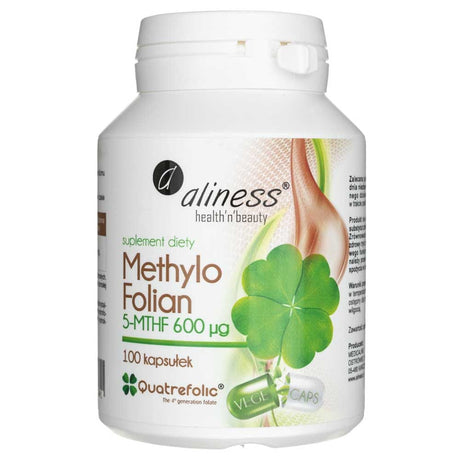


Aliness
Aliness Methylo Folian 5-MTHF 600 mcg - 100 Capsules
Regular price €11.39Unit price€0.11 each
Kenay
Kenay FOLATE 5-MTHF (active folic acid) Quatrefolic® - 60 Capsules
Regular price €9.49Unit price€0.16 each

Life Extension
Life Extension BioActive Folate & Vitamin B12 - 90 Veg Capsules
Regular price €10.39Unit price€0.12 each


Natural Food Sources of Folate
The word "folate" itself provides a clue to where this nutrient is found — it derives from the Latin folium, meaning "leaf." True to its name, folate is most abundant in green leafy vegetables. The richest dietary sources include:
- Spinach — one of the most concentrated natural sources of folate
- Brussels sprouts and lettuce
- Asparagus and cauliflower
- Avocado — a versatile and nutrient-dense source
- Legumes — lentils, chickpeas, and beans
Incorporating these foods into your daily diet is the most natural and effective way to maintain healthy vitamin B9 levels. These vegetables are widely available across European markets and contribute not only folate but a broad range of other essential nutrients.
Folate During Pregnancy — Why It Matters
Vitamin B9 — whether as folate or folic acid — is perhaps best known for its critical role during pregnancy. Adequate intake before conception and during the first trimester is essential for the normal development of the neural tube, which forms the baby's brain and spinal cord. This is why healthcare professionals across Europe recommend supplementation well before and throughout early pregnancy.
Given what we now understand about the differences in metabolism, many prenatal supplement formulations have begun to include methylfolate rather than — or in addition to — traditional folic acid. For women planning a pregnancy or currently expecting, choosing a prenatal supplement with the active folate form may offer more reliable support. Explore our pregnancy health collection for carefully selected prenatal supplements from trusted brands.


Doctor's Best
Doctor's Best Fully Active Folate 400 with Quatrefolic - 90 Veg Capsules
Regular price €14.29Unit price€0.16 each


Solgar
Solgar Folate 1333 mcg DFE (Metafolin® 800 mcg) - 100 Tablets
Regular price €19.29Unit price€0.19 each


How to Choose the Right Vitamin B9 Supplement
When shopping for a vitamin B9 supplement, look for products that specify the form of folate they contain. Labels that mention 5-MTHF, methylfolate, Metafolin®, or Quatrefolic® indicate the active, bioavailable form of vitamin B9. These patented forms are among the most widely trusted in the supplement industry and are used by leading brands including Solgar, Jarrow Formulas, NOW Foods, and Doctor's Best.
If you are choosing between a standard folic acid supplement and a methylfolate product, consider your individual needs. For general health maintenance and especially for cardiovascular support, the active folate form may offer a more efficient pathway. At Medpak, we carry both options — all shipped from within the EU for fast, convenient European delivery.
Key Takeaway: Folic acid and folate are both forms of vitamin B9, but they differ significantly in how the body processes them. Natural folate and its supplemental equivalent methylfolate (5-MTHF) are absorbed more efficiently, do not require liver conversion, and carry no risk of accumulation — making them the preferred choice for most people. Whether through a diet rich in leafy greens or through targeted supplementation, ensuring adequate vitamin B9 intake is essential for overall health, heart function, and especially foetal development during pregnancy.
This article is for information only and does not replace medical advice. If you have health concerns, are pregnant, breastfeeding or taking medication, consult a doctor or pharmacist. Dietary supplements are not a substitute for a varied diet.


